Whale Factoids
| Whales | Humpback Whale | Blue Whale | Beluga | Bowhead Whale | Gray Whale | Minke Whale | Top
| Narwhal | Right Whale | Sperm Whale | Fin Whale | Orca | Dolphins |

  • Whales breathe air into lungs. They are NOT fish. They are mammals that spend their entire lives in the water.
  • Whales have hair (although they have a lot less than land mammals, and have almost none as adults).
  • Whales can be divided into two groups – toothed whales and baleen whales.
  • Toothed whales (Odontoceti) - predators that use their peg-like teeth to catch fish, squid, and marine mammals, swallowing them whole. They have one blowhole (nostril) and use echolocation to hunt. There are about 66 species of toothed whales.
  • Baleen whales (Mysticeti) - predators that sieve tiny crustaceans, small fish, and other tiny organisms from the water with baleen. Baleen is a comb-like structure that filters the baleen whales' food from the water.
  • Baleen whales are larger than the toothed whales and have 2 blowholes (nostrils). There are 10 species of baleen whales.
  • The humpback's song can last for 30 minutes. Baleen whales sing low-frequency songs; toothed whales emit whistles and clicks that they use for echolocation.
  • Seven out of the 13 great whale species are still endangered or vulnerable after decades of protection.
  • Despite what many people think, whales and dolphins do not mate for life.
  • Do whales sleep? Not really. Whales have to be conscious to breathe so they never go into a “deep sleep” like humans do. Rather, they let one half of their brain sleep at a time and sleep about eight hours a day in this fashion.
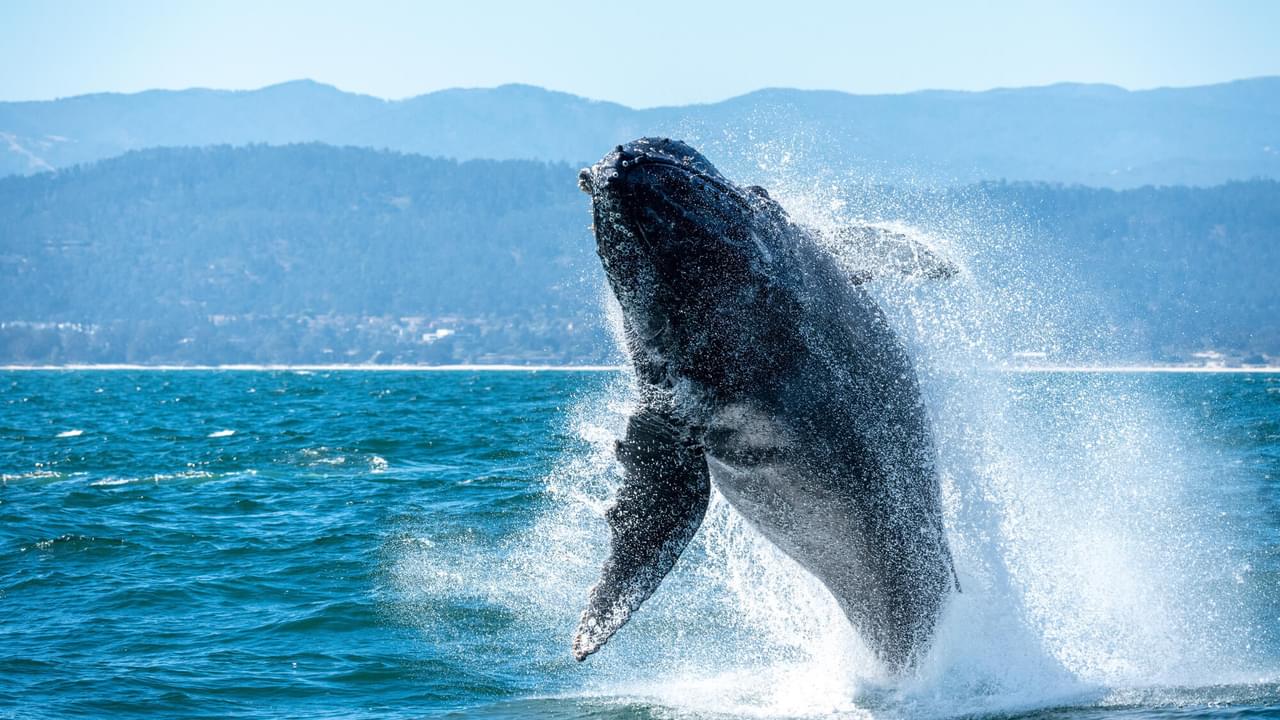
  • Take their name from their habit of exposing a large central area of their backs when diving. The name humpback describes the motion it makes as it arches its back out of the water in preparation for a dive.
  • They are the fifth largest animal on this planet, growing to a size equivalent to 11 elephants or 600 humans each.
  • Humpbacks are the most acrobatic of all of the great whales.
  • When it expels its breath, the resulting burst of air and water vapour can be seen for as far away as two kilometres on a clear day.
  • The breath rushes out at speeds up to 450 kph and can go up to a height of 5 metres.
  • The humpback has the largest pectoral fins of any of the great whales. The fins alone can weigh up to several tonnes.
  • Humpback whales are thought to produce the longest and most varied songs in the animal world, especially during the breeding season.
  • Only male humpbacks sing. Each sequence normally lasts 10 - 15 minutes and can be repeated without pause, for hours.
  • The four-chambered heart of the average humpback whale weighs about 430 pounds (195 kg) - about as much as three average adult human beings.
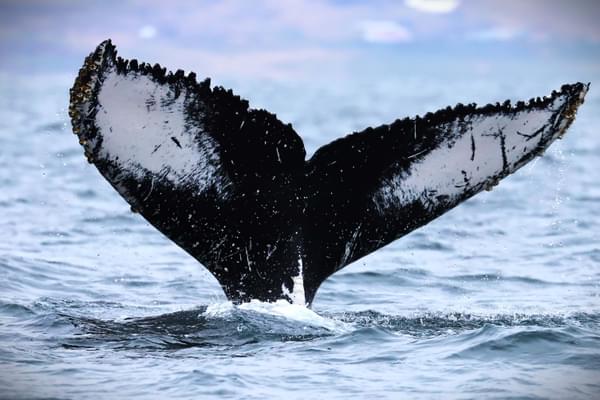
  • Humpbacks have huge, mottled white flippers with rough edges that are up to one-third of its body length; these are the largest flippers of any whale. The humpback's genus, Megaptera, means "huge-wings," referring to its flippers.
  • They have incredible powers of endurance, travelling over 3,100 miles during each seasonal migration with almost no rest along the way. During migrations, they cover over 1,000 miles per month.
  • A humpback consumes between 2,000 and 9,000 pounds of fish and krill a day.
  • A blue whale song may last ten hours.
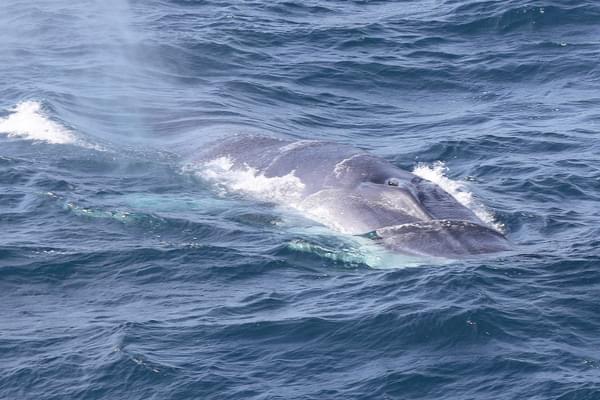
  • The biggest whale is the blue whale, which can grow to be about 94 feet (29 m) long - the height of a 9-story building.
  • These enormous animals eat about 4 tons of tiny krill each day, obtained by filter feeding through baleen.
  • Adult blue whales have no predators except man.
    The blue whale is the largest animal that has ever existed on Earth. It is larger than any of the dinosaurs were. They are also the loudest animal on Earth.
  • Weight: Up to 200 tons (larger than 30 elephants).
  • It needs 3,000,000 calories a day.
  • Blue whales grow to be about 80 feet (25 m) long on average, weighing about 120 tons (109 tonnes). The largest specimen found was a female 94 feet (29 m) long weighing more 174 tons (158 tonnes).
  • The heart is about the size of a Volkswagen bug car. A human could crawl through the aorta (a major blood vessel).
  • Tongue may weigh 22 tons .
  • Their call reaches levels up to 188 decibels. This low-frequency whistle can be heard for hundreds of miles. The blue whale is louder than a jet, which reaches only 140 decibels! Human shouting is 70 decibels; sounds over 120 decibels are painful to human ears.
  • Blue whales can dive for up to an hour, going to a depth of 350 feet (105 m).
  • Blue whales have a life expectancy of 35-40 years.
  • A blue whale's "blow" can reach almost 30 feet high.
  • There are up to 10,000 gallons of water, equal to 256,000 glasses of water, in each feeding mouthful of an adult blue whale. Of course, they don't swallow that salt water; they use their baleen to strain it out.
  • blue whale calf drinks about 130 gallons of milk per day, and gains up to 200 pounds per day during periods of its nursing period.
  • A 160 ton blue whale is equal in weight to 30 bull elephants, or 1830 adult humans weighing 175 pounds each.
  • A blue whale's eye is the size of a small teacup and their external ear is the size of the tip of a pencil.
  • Beluga means "white one" in Russian.
  • It has no dorsal fin, which makes swimming under Arctic ice sheets easier.
  • They swallow their prey whole.
  • An adult beluga will eat about 2.5% to 3% of its body weight per day, or 50 pounds (25 kg) of food a day, or more.
  • Belugas usually dive for about 3-15 minutes while hunting for food.
  • They can travel for about 1.5 miles (2.5 km) during a dive and commonly dive to a depth of 66 feet (20 m) to hunt. They can dive to a depth of about 1,300-2,100 feet (400-650 m) at times.
  • Belugas are also known as "sea canaries" because of their songs and chatter, which can even be heard above the water.
  • The gestation period of the beluga is about 14-15 months.
  • Beluga whales have a life expectancy of 25-30 years.
  • White whales are one of the few whales that can turn their head. Other whales have fused neck bones. The beluga, however, can turn its head right, left and up-and-down. They also can "make faces." They don't smile or frown like people, but have flexible lips and forehead
  • Large, bow-shaped head that is up to 40% of its body length.
  • The arched mouth is up to 10 feet (3 m) wide and 20 feet (6 m) deep.
  • Bowhead whales can dive for almost an hour, but dives usually last 4-15 minutes. They can go to a depth of 500 feet (155 m).
  • Whalers used to call them "devilfish" because of their fierce defence they put up when hunted.
  • Gray whales can dive for up to 30 minutes and go 500 feet (155 m) deep.
  • Gray whales make the longest seasonal migration of any of the whales. They travel about 12,500 miles each year.
  • The minke whale is the smallest baleen whale.
  • It is known as the “cheetah of the whales”.
  • The Narwhal (meaning "corpse whale" in Old Norse).
  • All narwhals have two teeth in their upper jaw. After the first year of a male narwhal's life, its left tooth grows outward, spirally. This long, single tooth projects from its upper jaw and can grow to be 7-10 feet (2-3 m) long.
  • Tusks are usually twisted in a counter clockwise direction and have a hollow interior.
  • Right whales were named by whalers who considered them the "right" whales to hunt, since they were rich in blubber, they were easy to catch (they are relatively slow swimmers) and they floated after being killed.
  • The northern right whale is one of the most endangered of cetaceans, numbering just over an estimated 300 animals.
  • Southern right whales have been seen to raise their flukes in the wind and use them as sails.
  • It has a huge brain that weighs about 20 pounds (9 kg); it is the largest brain of any animal.
  • The fictional Moby Dick was a sperm whale.
  • Sperm whales are the largest toothed whales.
  • The four-chambered heart of the average sperm whale weighs about 277 pounds (126 kg) - about as much as two average adult human beings.
  • Sperm whales have the largest head of any animal. It can be about 20 feet long (6 m), 10 feet high (3 m), and 7 feet (2.1 m) across, and is about one-third of the whale's body length.
  • The sperm whale was named for the valuable spermaceti oil (wax) that this whale produces in the spermaceti organ (located in its head).
  • The Sperm whale can hold its breath for about an hour.
  • The sperm whale dives the deepest of all whales. It goes as deep as 10,500 feet (3,200) below the surface to hunt for giant squid.
  • The sperm whale family pod is directed by the biggest female, since their society is a matriarchal one.
  • Sperm whales form strong kinship bonds with the other members of the pod. Mass strandings are often caused when the head female becomes sick and strands. The others follow her, because they are accustomed to following what she does.
  • It smashed the boats of early whalers into splinters.
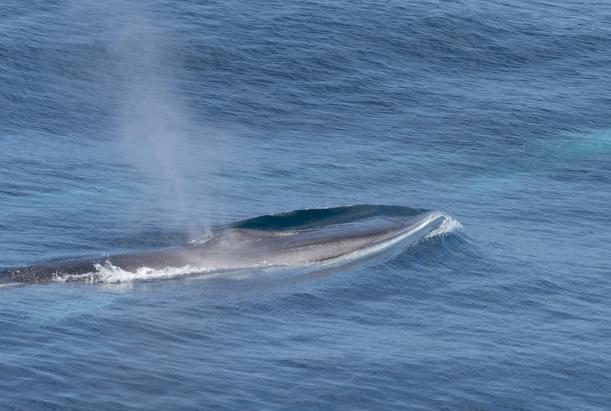
  • Fin whales are one of the fastest whales, and can hit top speeds of over 35km per hour!
  • Despite its size and common name "Killer Whale", the Orca is, in fact, the largest dolphin, and is more closely related to smaller dolphins than to the 'great' whales.
  • The male Orca's dorsal fin is a tell-tale giveaway, being as tall as a man.
  • It is sometimes called the "wolf of the sea" because its behaviour is similar to that of wolves.
  • Smarter and easier to train than a dolphin.
  • In addition to eating salmon, seals, whales, dolphins, and sea birds, killer whales (orca) have been seen to kill and eat swimming deer and moose!
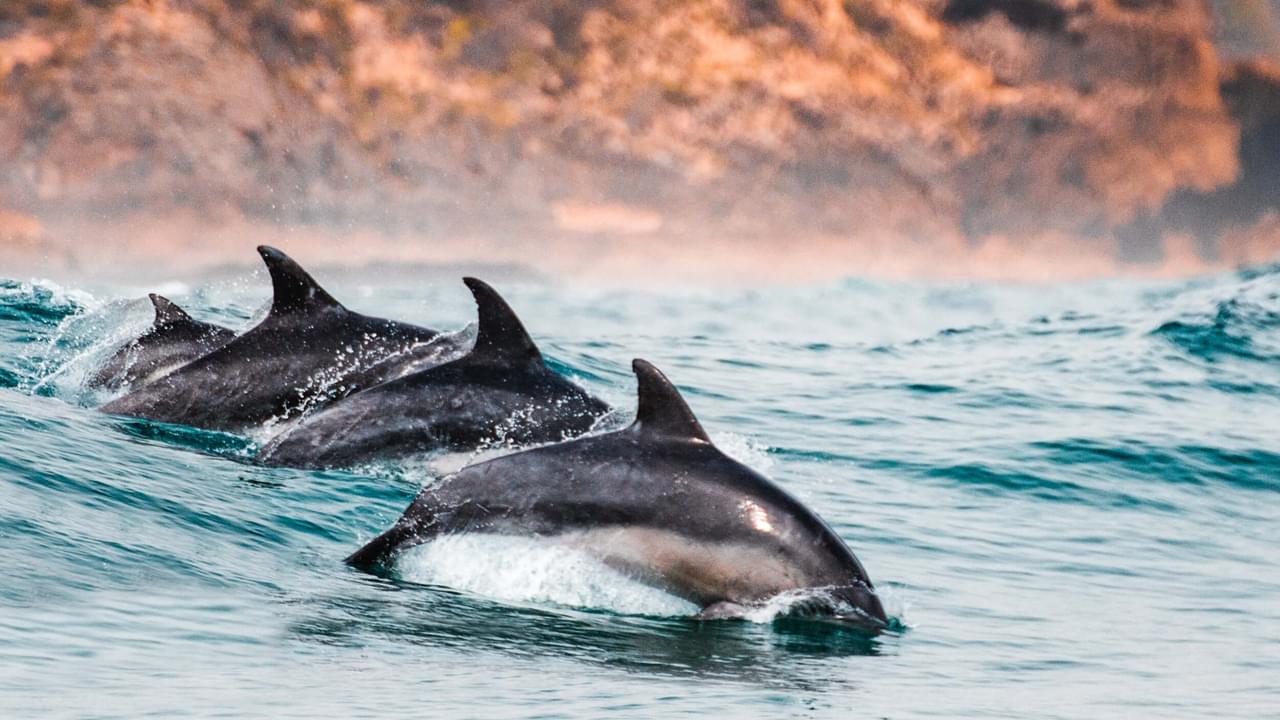
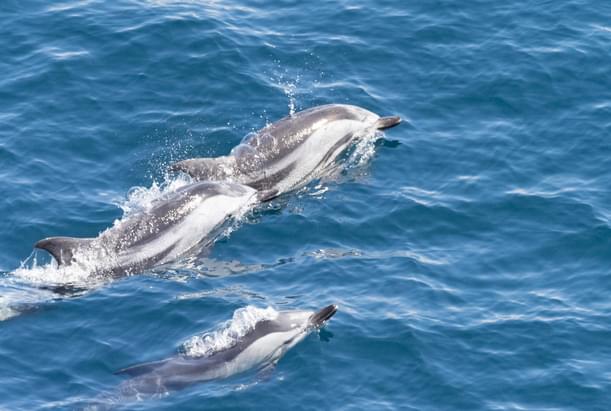
  • The Bottle-Nosed Dolphin is the best-known of the species.
  • Bottle-nosed dolphins grow up to 4 metres long and can weigh as much as 250Kg.
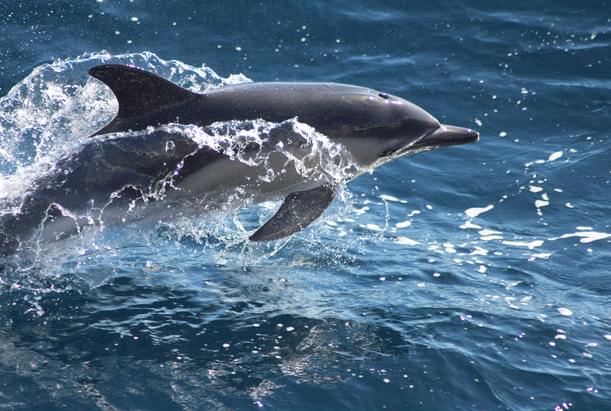
  • Dolphins can dive down to more than 1,000 feet (300 m) and can jump up to 20 feet (6 m) out of the water.
  • They need to breathe about every 2 minutes, but can hold their breath for several minutes.
  • Bottlenose dolphins have a maximum life span of about 25 years.
  • The vaquita, a relative of the harbor porpoise found in the Sea of Cortez, is commonly regarded as the smallest cetacean in the world with a length of only 4 feet.
  • Some freshwater dolphins are blind and only use their sonar to "see".
  • Dolphins sleep only with one half of their brain at a time ! Dolphins are conscious breathers. Should they sleep and go unconscious as we do they would simply suffocate or drown. Sleeping Dolphins can be seen as resting, floating at the surface, with one eye open. After a time, they will close the one eye and open the other one. They alternate like this throughout their entire nap.
  • The Hector's dolphin is the rarest dolphin in the world.
  • The pigment of a dolphin's back allows it to blend into its aquatic surroundings.
  • It is well known that dolphins can see inside the bodies of their fellow dolphins, and other animals in the water. This is because dolphin sonar evolved to pass through water and does not reflect until it hits something like bone or air sacs. Since animal bodies are more than 50% water, their sonar enables them to literally "see" inside other animals.
  • It is possible that dolphins can read the emotion of other dolphins and "see" through the bodies of other animals due to their "x-ray" vision.
  • Dolphins have teeth, a four chambered heart (like humans) and even have a light covering of hair.
  • Porpoises and dolphins are related, but they are not the same animal. Dolphins have a larger forehead and round teeth when sub sectioned. Porpoises are slimmer and have flat teeth when sub sectioned.
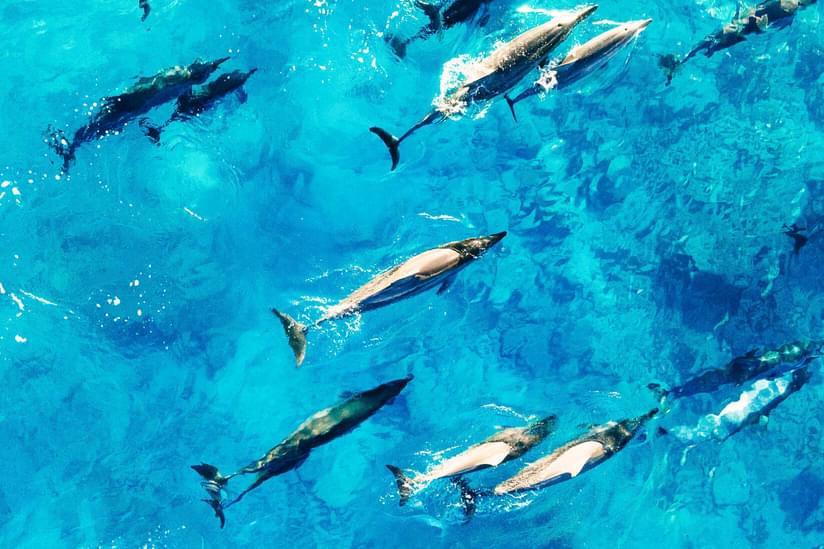
  • There are 32 species of oceanic dolphins and 5 species of river dolphins.
  • Dolphins have astute sound, keen vision, touch and taste senses, although they cannot smell.
  • A dolphin sheds its outer layer of skin every two hours.
  • Every dolphin has its own signature whistle to distinguish itself from its companions much like a human fingerprint.
  • Dolphins evolved from land mammals.
  • Deep within a dolphin's body it's temperature is normally 35 degrees to 36.9 degrees, while it's outer body temperature is usually cooler. In comparison, man's body temperature is 37.3 degrees
    Dolphins closest land relatives are thought to be cows, pigs and deer.
  • Unlike any other mammal, dolphin babies are born tail first.
  • Dolphins, like cows, have two stomachs — one for storing food and one for digesting it.
    A dolphin's dorsal fin is as distinctive as a person's face.
  • Some dolphin species can swim up to 25 miles an hour for long periods, more than three times faster than the best human swimmers.
  • Some dolphins can hold their breath for as long as 30 minutes, while others have to breathe every 20 seconds.
  • Bonds form between individual dolphins that may last a lifetime. They've been observed physically supporting sick or dying pod members.
  • An adult dolphin may consume 30 pounds of fish or more in a single day.
  • Dolphins swallow fish whole, despite the 100 teeth in their mouths. The teeth are used to grasp prey.
  • The largest member of the dolphin family is the killer whale, which can grow to 30 feet long.
  • It has been suggested that the reason dolphins always seem to be grinning is that they understand our language and are patiently waiting for us to learn theirs.